
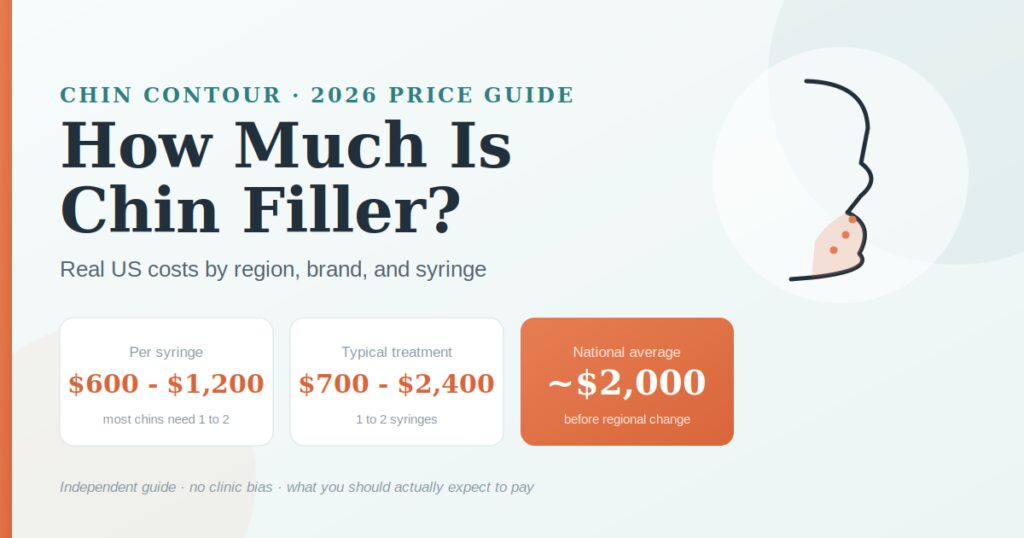
In the US in 2026, chin filler costs about $600 to $1,200 per syringe, and since most chins need one to two syringes, a typical treatment runs roughly $700 to $2,400, with a national average near $2,000. Prices are highest in coastal cities and at plastic surgeons, and lowest in mid market cities and at med spas. The table below breaks how much is chin filler.
Chin filler cost at a glance (2026)
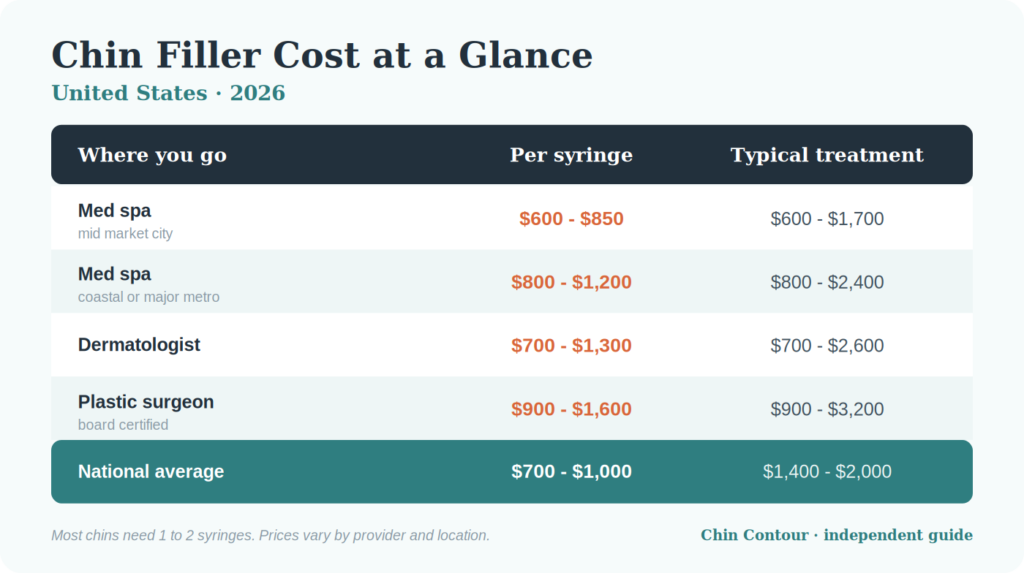
| Where you go | Typical cost per syringe | Typical chin treatment (1 to 2 syringes) |
|---|---|---|
| Med spa (mid market city) | $600 to $850 | $600 to $1,700 |
| Med spa (coastal or major metro) | $800 to $1,200 | $800 to $2,400 |
| Dermatologist | $700 to $1,300 | $700 to $2,600 |
| Board certified plastic surgeon | $900 to $1,600 | $900 to $3,200 |
| National average | around $700 to $1,000 | around $1,400 to $2,000 |
This single table answers the core question fast, but the right number for you depends on your region, the filler brand, how many syringes you need, and who injects you. The rest of this guide breaks down each of those so you can budget accurately and avoid overpaying. Chin Contour is independent, we do not run a clinic and we do not sell injections, so this is the full national picture rather than one clinic’s price list.
Chin filler cost by US region
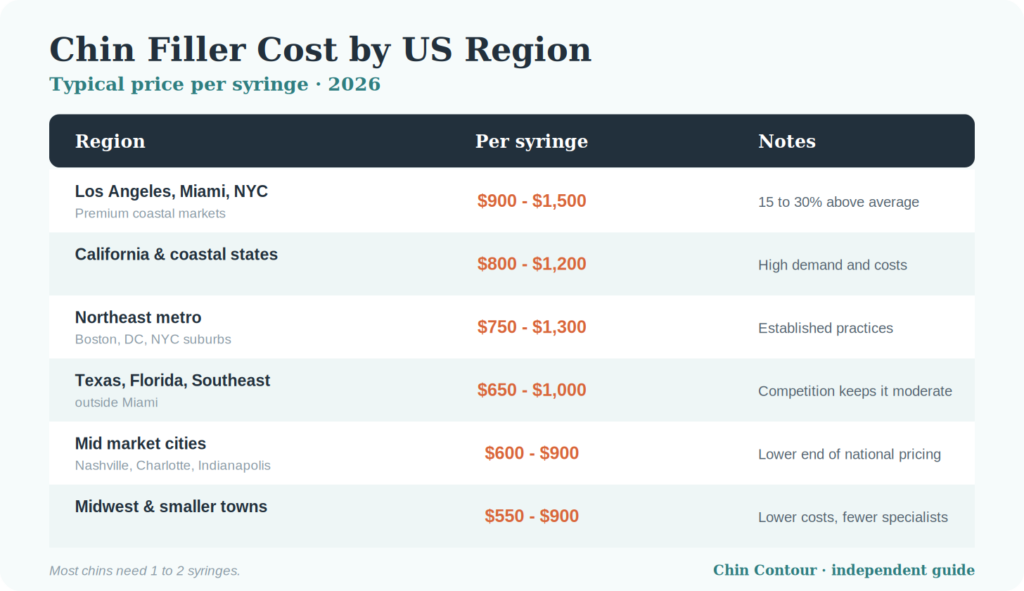
Location is one of the biggest factors in your final bill, because rent, local demand, and the number of skilled injectors all vary by market. These are typical 2026 per syringe figures. Since a chin usually needs one to two syringes, multiply accordingly.
| Region | Typical cost per syringe | Notes |
|---|---|---|
| Los Angeles, Miami, New York City | $900 to $1,500 | Premium coastal markets, often 15 to 30 percent above the national average |
| California (broader) and coastal states | $800 to $1,200 | High demand and high operating costs push prices up |
| Northeast metro (Boston, DC, NYC suburbs) | $750 to $1,300 | Established practices with board certified injectors |
| Texas, Florida (outside Miami), Southeast | $650 to $1,000 | Strong competition keeps prices moderate |
| Mid market cities (Nashville, Charlotte, Indianapolis) | $600 to $900 | Tends to track the lower end of national pricing |
| Midwest and smaller towns | $550 to $900 | Lower operating costs, though fewer specialist injectors |
For two syringes in a coastal city, a realistic budget is $1,800 to $3,000. The same treatment in a mid market city might fall between $1,200 and $1,800.
Chin filler cost by clinic type
Where you get treated changes the price as much as where you live, because a med spa, a dermatologist, and a plastic surgeon carry different overheads and different levels of medical training. None is automatically right or wrong, but you should know what you are paying for.
- Med spas are usually the most affordable option, often with injectors who are registered nurses or physician assistants working under a medical director. Prices frequently start lower, but experience varies widely between spas, so vetting the individual injector matters.
- Dermatologists sit in the middle to upper range and bring strong skin and facial expertise, which is reassuring for safety.
- Board certified plastic surgeons and facial plastic surgeons are typically the most expensive, and that premium reflects the deepest anatomical training and the ability to manage complications, which matters most for structural work near the chin and jaw.
Chin filler cost by brand
Not all fillers cost the same, because the chin needs a firm, structural product that can mimic bone and hold its shape. These denser fillers cost more than the soft gels used for lips, but they also tend to last longer, which improves the overall value.
| Filler | Typical cost per syringe | How long it lasts | Best for |
|---|---|---|---|
| Juvederm Volux XC | $900 to $1,600 | Up to 2 years | Chin and jawline definition, the first filler FDA approved specifically for the jawline |
| Juvederm Voluma XC | $800 to $1,500 | Up to 2 years | Chin projection and structural lift, FDA approved for chin augmentation |
| Restylane Defyne | $400 to $800 | Up to 1 year | Chin enhancement with a slightly softer, flexible result |
| Radiesse (calcium based) | $700 to $900 | 12 to 18 months | Structure plus collagen stimulation, but it cannot be dissolved |
The two products most often used for the chin, Juvederm Voluma XC and Volux XC, sit at the higher end for a real reason. They use the densest formulation in the range, are injected deep near the bone, and demand more skill to place safely. A board certified injector charging $1,200 or more for Volux is not overcharging you, you are paying for both a premium product and the expertise to use it correctly.
How many syringes does a chin actually need?
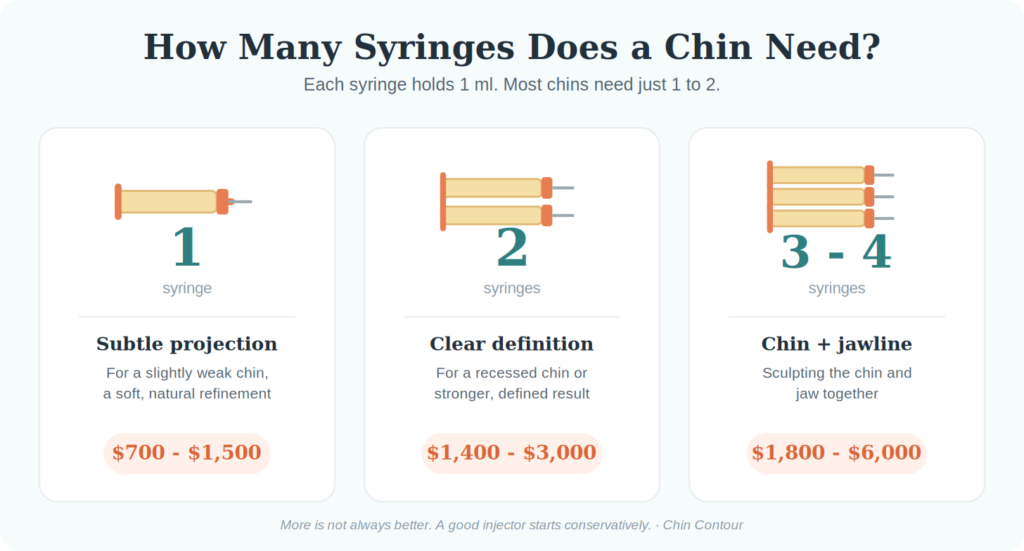
Chin filler is priced per syringe, and each syringe holds one millilitre, so the number of syringes is the single biggest driver of your total cost. The good news is that the chin is a small area, so most people need less than they expect.
| Goal | Syringes typically needed | Typical total cost |
|---|---|---|
| Subtle projection for a slightly weak chin | 1 syringe | $700 to $1,500 |
| Clear definition or correcting a recessed chin | 2 syringes | $1,400 to $3,000 |
| Chin and jawline sculpting together | 3 to 4 syringes | $1,800 to $6,000 |
If a provider recommends far more product than this for a chin alone, it is fair to ask why. A skilled injector often prefers to start with one to two syringes and add later, which protects both your budget and a natural looking result.
The real cost of chin filler over time
This is the number almost no clinic puts in front of you, and it is the most important one. Chin filler is temporary. Hyaluronic acid is gradually broken down by your body, so the result fades over roughly one to two years, and maintaining it means repeat treatments.
If you love your result and want to keep it, plan for a top up every twelve to eighteen months on average. Over five years, that typically adds up to somewhere between $2,500 and $9,600, depending on how many syringes you use and how often you refresh. Seeing that full picture changes the decision, because it is very different from the single session price a clinic quotes. This is exactly why the comparison to a permanent option matters, which brings us to implants.
Chin filler versus a chin implant: when does filler stop being worth it?
A chin implant is a permanent surgical solution that typically costs $3,500 to $6,000 as a one time procedure. Filler is cheaper up front and needs no surgery, which makes it an excellent low risk way to test a stronger chin before committing to anything permanent.
The honest crossover point is this: because filler needs regular maintenance, after roughly five rounds of treatment you will often have paid as much as a chin implant would have cost, without a permanent result to show for it. That does not make filler the wrong choice, its adjustability, reversibility, and zero downtime are real advantages, especially for a first time enhancement. But if you already know you want a lasting change to a genuinely recessed chin, an implant may be the more sensible long term investment. If your goal is simply to try the look, or to make a subtle refinement, filler is usually the smarter starting point. You can see what that result looks like in our guide to chin filler before and after.
Where people quietly overpay for chin filler
Because filler pricing is rarely transparent, it is easy to pay more than you should, or to pay a fair price for the wrong product. These are the traps worth knowing before you book.
- “Starting at $499” style pricing. This almost always refers to the cheapest product in the smallest quantity for the simplest case. Real chin filler with a structural product like Volux or Voluma will cost meaningfully more, so treat the headline number as bait rather than your likely bill.
- Suspiciously cheap premium filler. If someone offers Juvederm Voluma or Volux at around $500 a syringe, be cautious. Genuine premium filler rarely costs that little, and unusually low prices can signal a diluted, counterfeit, or improperly stored product. With something injected into your face, the cheapest option is not where to cut corners.
- Paying for volume you do not need. More syringes is not automatically a better result. Overfilling a chin looks unnatural, and it costs you more. A good injector treats conservatively.
- Ignoring longevity. A cheaper, thinner filler may save money today but fade in six to nine months, meaning you pay again sooner. A firmer, longer lasting product often costs less per year of results, even if the syringe price is higher.
A legitimate cost that is not a trap is a small touch up. Many experienced patients book a half syringe, often around $350, partway through the filler’s lifespan to refine the result and correct any settling. That is a reasonable strategy, not an upsell.
What actually determines your price
Pulling it together, five factors decide what you pay for chin filler:
- Number of syringes, the biggest driver, since pricing is per syringe.
- Filler brand and type, with structural products like Volux and Voluma costing more than soft gels.
- Injector experience, where a board certified dermatologist or plastic surgeon charges more but brings lower risk.
- Location, with coastal and major metro areas running well above mid market cities.
- Complexity, since correcting asymmetry, a recessed chin, or blending into the jawline needs more product and skill than a simple refinement.
How to get an accurate quote
Because online averages only take you so far, the only way to know your real cost is a consultation. To get a number you can trust, ask your provider three things: how many syringes they estimate for your goal, exactly which filler brand and formula they will use, and whether the price includes a follow up or touch up visit. A transparent provider answers all three clearly and gives you a written estimate. If you are unsure whether filler is even the right treatment, or whether fat rather than projection is the real issue, our guide to Kybella before and after explains the alternative for a fat based double chin.
Frequently asked questions
How much is chin filler on average?
In the US in 2026, chin filler averages around $2,000 for a typical treatment, with a common range of about $700 to $2,400 depending on how many syringes you need and where you live. Per syringe, expect roughly $600 to $1,200.
How many syringes of filler do you need for the chin?
Most people need one to two syringes for the chin. Adding jawline definition can take three to four syringes in total. The exact amount depends on your anatomy and goals.
Why is chin filler more expensive than lip filler?
The chin needs a firmer, denser, structural filler such as Juvederm Volux or Voluma, which costs more than the softer gels used in the lips, and it is injected deep near the bone, which requires more skill.
Is chin filler cheaper than a chin implant?
Yes, up front. Filler costs far less than the $3,500 to $6,000 of an implant for a single session. However, because filler is temporary, the long term cost of maintaining it can eventually match the cost of a permanent implant.
How long does chin filler last, and how often will I pay again?
Chin filler generally lasts one to two years, with longer lasting products like Voluma and Volux at the top of that range. Maintaining the result usually means a repeat treatment every twelve to eighteen months.
Does insurance cover chin filler?
No. Chin filler is an elective cosmetic treatment, so it is not covered by health insurance, and you should plan to pay out of pocket.
Resources and references
- Dermal Fillers (Soft Tissue Fillers) — U.S. Food and Drug Administration (FDA) — official FDA information on approved uses of dermal fillers, including chin augmentation, plus safety guidance.
- Clinical Overview of Dermal Fillers — U.S. Food and Drug Administration (FDA) — an FDA document on how soft tissue fillers are used and regulated.
This article is for education only and is not medical advice. Prices are national estimates for 2026 and will vary by provider and location. Chin Contour is independent and not affiliated with any clinic. Always confirm current pricing and suitability directly with a qualified, medically trained provider.

Harper Hayes is the founder and lead researcher behind Chin Contour, an independent resource for chin and jawline treatment information. She is not a doctor or clinic owner and has no ties to the aesthetics industry, so her only focus is giving readers unbiased, easy to understand answers. Harper spends her time studying clinical research, trusted expert sources, and real patient experiences, then translating it all into plain language, helping you make confident, well informed decisions about chin contouring, fillers, and double chin treatments.