
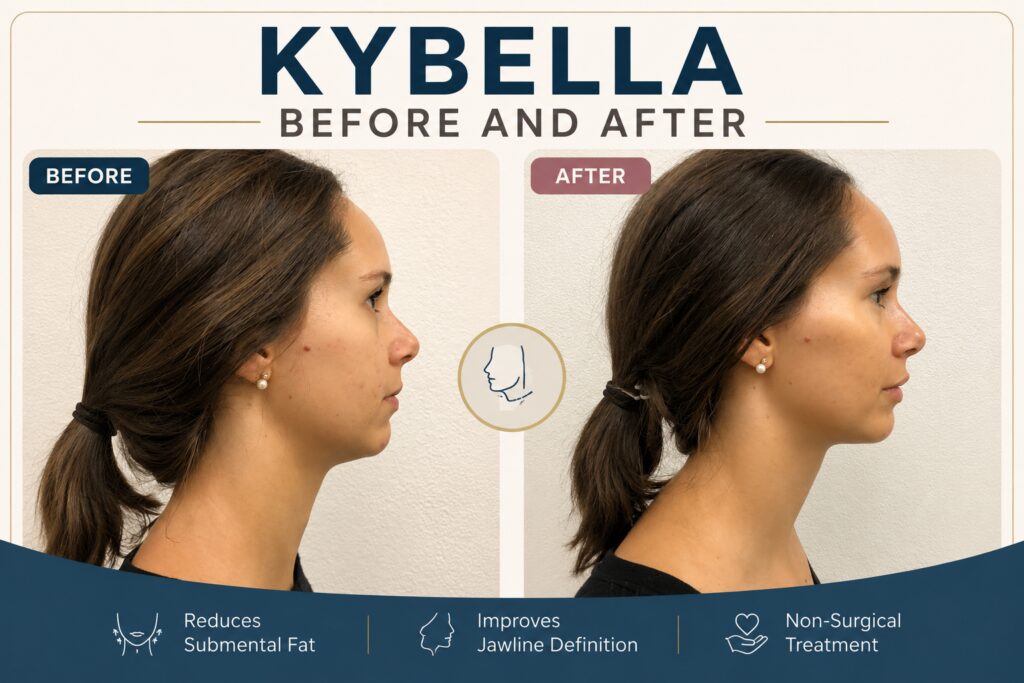
Quick answer: Kybella is an FDA approved injectable that permanently destroys fat cells under the chin, so a realistic before and after shows a slimmer, more sculpted profile that develops gradually rather than overnight. Most people need two to four sessions spaced four to six weeks apart, and the true difference becomes clear around four to six weeks after treatment, once the swelling has settled. Because the destroyed fat cells cannot return, the result is considered permanent as long as your weight stays stable.
If you have searched “Kybella before and after,” you have almost certainly landed on a wall of clinic galleries, each one paired with a booking button and very little context. This guide takes a different approach. Chin Contour is independent, we do not run a clinic and we do not sell injections, so our only goal here is to explain what Kybella before and after results honestly look like, how long they take to appear, what they cost, what can go wrong, and when Kybella is simply the wrong choice. By the end, you should be able to look at any before and after photo and judge it for yourself.
What is Kybella and how does it work?
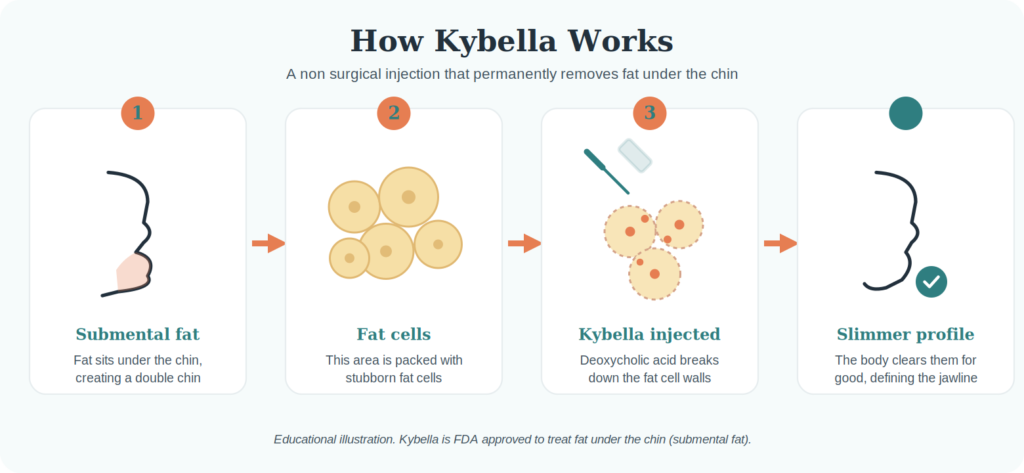
Kybella is the brand name for deoxycholic acid, a molecule that occurs naturally in the human body, where it helps break down and absorb dietary fat. In a treatment, a purified, synthetic version of that molecule is injected in small amounts across the area under the chin. Once inside the fat layer, it damages the walls of the fat cells so that they can no longer store fat. Over the following weeks, your body clears away those destroyed cells through its normal waste processes, and the area gradually becomes slimmer.
The area Kybella treats has a specific name: submental fat, meaning the fat that sits below the chin and creates the appearance of a double chin. This detail matters, because Kybella is FDA approved for this exact area and nothing else. When you see it used on other parts of the body, that is an off label application and should be discussed carefully with a qualified provider.
Two things make Kybella distinct from most other chin treatments. First, it removes fat rather than adding volume or freezing tissue. Second, its effect is permanent, because a destroyed fat cell does not grow back. That combination is exactly why the before and after results look the way they do.
What a Kybella before and after actually shows
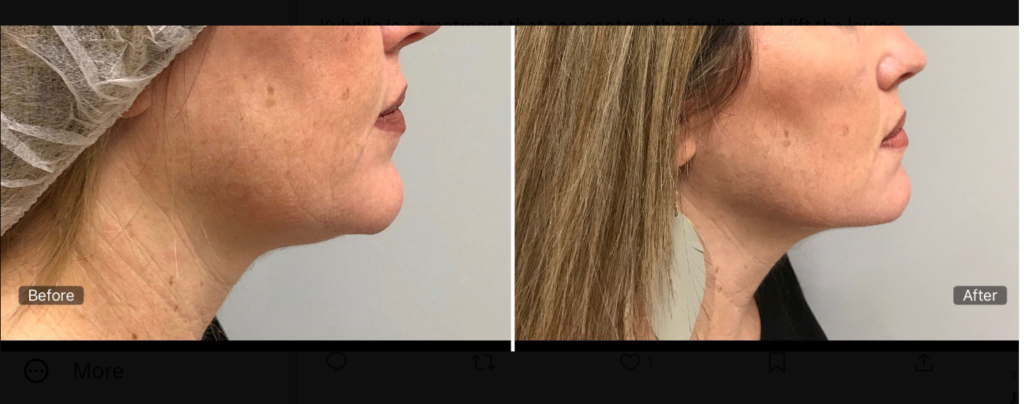
A realistic Kybella before and after is a story of gradual refinement, not an instant transformation. In the before image, the area under the chin looks full or soft, and the line where the chin meets the neck is blurred. In a good after image, taken weeks later, that fullness has reduced, the jawline reads as a cleaner line, and the profile looks more defined.
The change is almost always most visible from the side. Front facing selfies rarely show a double chin clearly, which is why honest galleries lean on profile shots. Someone with mild fullness might see a subtle sharpening of the jawline, while someone with moderate fullness may see a more obvious slimming of the whole under chin area.
It is just as important to understand what Kybella does not do. It does not tighten loose or sagging skin, and it does not add projection to a chin that is naturally weak or recessed. If your concern is skin laxity, or a chin that sits too far back, Kybella is not the answer to that particular problem, and a good before and after for one issue will look like no change at all for the other.
The Kybella before and after timeline, week by week
This is where a lot of before and after photos quietly mislead people, because a photo taken while the chin is still swollen looks completely different from the settled result. Understanding the timeline is the single best way to set realistic expectations and to avoid panicking in the first week. Here is what typically happens after each session.
- Days 1 to 3: Swelling is at its most noticeable, and the area often feels firm, tender, and slightly numb. Many people are surprised that the under chin looks fuller at this stage, not slimmer. This is completely normal and is actually a sign that the deoxycholic acid is working.
- Days 3 to 7: Swelling usually peaks around days three to five and then starts to ease. If you are going to bruise, this is when it is most visible. Some people prefer to schedule treatment when they have a few quiet days ahead.
- Weeks 2 to 4: The majority of the swelling settles during this period. The shape starts to look natural again, and the first hints of real improvement become easier to see.
- Weeks 4 to 6: This is when the genuine difference from a single session usually shows, as your body finishes clearing the destroyed fat cells. Providers often schedule a review around this point to decide whether another session is needed.
- After your final session: Full results generally appear around eight to twelve weeks after your last treatment, once every session has fully settled and the area has completely recovered.
The honest takeaway is that you may see little or no change after your first session, particularly if you have moderate fat. That does not mean the treatment failed. Kybella builds its result across the whole series, not from a single visit, and judging the outcome too early is the most common reason people wrongly assume it did not work.
How many Kybella sessions will you need?
Kybella is delivered as a series of sessions rather than a single injection, and this is one of the most important things to understand before you commit. The number of sessions depends on how much submental fat you have and how dramatic a change you want. Most patients need two to four sessions, and the FDA approves a maximum of six. Sessions are spaced roughly four to six weeks apart so that your body has time to process the destroyed fat and the swelling has time to settle between visits.
| Amount of submental fat | Sessions often needed |
|---|---|
| Mild fullness | 1 to 2 sessions |
| Moderate fullness | 2 to 4 sessions |
| Significant fullness | 4 to 6 sessions |
Each session involves a series of small injections spread across the treatment area, guided by a temporary marking grid, and it usually takes only fifteen to twenty minutes. A good provider will assess your chin and neck in person before estimating a plan, because the right number of sessions genuinely cannot be judged reliably from a photo alone. If anyone promises you a fixed result in a fixed number of sessions before meeting you, treat that as a warning sign rather than a reassurance.
How much does Kybella cost?
Kybella is priced per vial, and each vial holds two millilitres of solution. Your total cost depends on how many vials each session needs and how many sessions you require overall, so an honest answer is always a range rather than one figure.
| Item | Typical cost in the United States |
|---|---|
| Per vial (2 mL) | $600 to $1,000 |
| Single session | $1,200 to $1,800 |
| Full series (2 to 4 sessions) | $2,400 to $6,000 |
Several factors move you within these ranges: your geographic location, the training and reputation of your injector, and the amount of fat being treated. It is worth being cautious about unusually cheap offers, since Kybella is highly technique sensitive and the skill of the injector directly affects both your safety and your result. For a full breakdown of pricing, vial counts, and how to budget for a complete series, see our detailed Kybella cost guide. One point that often gets overlooked is that because the result is permanent, there is no ongoing maintenance cost once your series is finished, which sets it apart from temporary treatments that need regular topping up.
Does Kybella actually work?
Kybella is not based on marketing alone. It went through clinical trials before earning FDA approval in 2015, and those trials give us honest numbers to work with. Across two clinical studies, roughly 68 percent of patients treated with Kybella experienced at least some or moderate improvement in their submental fullness, compared with around 20 percent of patients who received a placebo. About 16 percent of treated patients saw a significant improvement.
These figures are genuinely helpful for setting expectations. They confirm that Kybella works for suitable candidates, but they also show that the typical result is best described as a clear, noticeable improvement rather than an extreme change. Your own outcome depends heavily on two things you can partly control: whether you are a good candidate in the first place, and whether you choose a skilled, experienced injector.
How to read Kybella before and after photos without being misled
Once you understand what to look for, many dramatic before and after photos become far less convincing, and a few become outright misleading. A difference in a photo does not always mean a difference in the chin. These are the factors that quietly change how a result appears.
- Timing: An after photo taken during peak swelling can look fuller, while one captured at a flattering moment can exaggerate a result. The fairest comparison is taken at least four to six weeks after the final session.
- Head angle and tilt: Tilting the chin down and slightly forward instantly creates a sharper jawline in any photo, with or without treatment. Trustworthy comparisons keep the head in the exact same position in both shots.
- Lighting: Harsh overhead light carves out shadows and manufactures definition, while soft, flat light does the opposite. If the two photos are lit differently, the comparison means very little.
- Lens and distance: A close phone selfie distorts facial proportions, while a step back with a longer lens flatters them. The camera setup should match in both images.
- Weight change: A patient who also lost weight during the treatment series will show a bigger change that is not entirely due to Kybella. Weight should be stable for a fair comparison.
The rule of thumb is simple. Only trust before and after photos that are shot in identical lighting, at the same angle and distance, with stable weight, and taken several weeks after treatment. When those conditions are met, the result you see is a result you can believe.
Honest side effects and risks
Kybella is non surgical, but it is still a real medical treatment, and swelling in particular is a normal part of the process rather than a rare complication. Being clear about this in advance is far better than being surprised by it afterward. The realistic side effects and risks include:
- Swelling, bruising, numbness, pain, and firmness in the treated area. Swelling is expected and can last one to two weeks, occasionally longer. In clinical trials, around 72 percent of patients experienced some bruising, so it is common rather than unusual.
- Marginal mandibular nerve injury, reported in about 4 percent of trial patients. This can cause a temporarily uneven smile or mild muscle weakness, and in the studies every case resolved on its own over time.
- Difficulty swallowing, known as dysphagia, reported in about 2 percent of trial patients in the setting of swelling, which also resolved on its own.
- Skin laxity. Because Kybella removes fat, some patients notice mild looseness afterward if their skin does not retract well, which is more likely with lower skin elasticity.
The most effective way to reduce these risks is not complicated. Choose an experienced, medically trained injector who understands the anatomy of the neck, rather than the cheapest option available, because the precision of the injection placement directly affects both safety and results.
Who is not a good candidate for Kybella
An honest provider will sometimes tell you that Kybella is not the right treatment for you, and understanding why in advance saves both money and disappointment. Kybella may not suit you if:
- Your under chin fullness is mainly loose skin rather than fat. Kybella reduces fat, it does not tighten skin, so treating skin laxity with it will not deliver the result you want.
- You have prominent neck bands or significant skin laxity, which can limit how clean the final contour looks even after fat is reduced.
- You have a history of difficulty swallowing, since Kybella can aggravate that condition.
- You have an active infection in the treatment area, or you are pregnant or breastfeeding, in which case treatment should be postponed and discussed with your provider.
If your real concern is a weak or recessed chin rather than fat, then filler is a completely different tool that adds projection instead of removing fat. You can compare the two approaches directly in our guide to chin filler before and after.
Kybella compared to the alternatives
The clearest way to judge Kybella is to place it beside the other common options for the chin and jawline. They are not interchangeable, because some remove fat, one adds volume, and one is surgical. The right choice depends entirely on what is actually causing the appearance you want to change.
| Option | How it works | Downtime | Permanence |
|---|---|---|---|
| Kybella | Injections dissolve submental fat over a series of sessions | Mild, with swelling for days to weeks | Permanent with stable weight |
| Chin filler | Adds volume to project the chin, does not remove fat | Minimal | Temporary, roughly 6 to 18 months |
| Chin liposuction | Surgically removes fat in a single procedure | More downtime and aftercare | Permanent, in one procedure |
| CoolSculpting | Freezes and destroys fat cells non surgically | Minimal | Permanent, often fewer sessions |
If a fat based double chin is your concern and you want to avoid surgery, Kybella and CoolSculpting are the two main non surgical routes, and they differ mainly in how the fat is destroyed and how many sessions are typically needed. If you want a single, dramatic result and are open to a minor surgical procedure, chin liposuction may suit you better. And if your issue is projection rather than fat, filler is the tool to research instead. Matching the treatment to the actual cause is the difference between a result you love and money spent on the wrong problem.
Is Kybella permanent?
Yes, within reason. Once Kybella destroys a fat cell, that cell cannot come back or store fat again, so the fat that is treated is gone for good. This is the main reason Kybella appeals to people who are tired of temporary treatments.
The important caveat is weight. While the treated fat cells are permanently gone, the fat cells that remain in the surrounding area can still expand if you gain a significant amount of weight, which can soften the definition you worked for. With a stable weight, most people can reasonably consider their Kybella result long lasting and effectively maintenance free.
Frequently asked questions
How long does Kybella swelling last?
Swelling usually peaks within the first few days and then eases over one to two weeks. Some patients have minor residual swelling for up to four to six weeks, which is still within the normal range.
When will I see my Kybella results?
Visible improvement from a single session typically appears around four to six weeks later. Full results generally show around eight to twelve weeks after your final session, once everything has settled.
How many Kybella treatments will I need?
Most people need two to four sessions spaced about four to six weeks apart. Patients with more submental fat may need up to the FDA approved maximum of six.
Is Kybella permanent?
Yes. The destroyed fat cells do not return, so the result is considered permanent as long as your weight stays stable over time.
Does Kybella hurt?
Discomfort is generally mild. A numbing agent or ice is usually applied first, and most people describe a stinging or pressure sensation during the injections rather than sharp pain.
Is Kybella better than chin liposuction?
Neither is universally better, because they suit different people. Kybella is non surgical and gradual over several sessions, while liposuction delivers a single, more dramatic result with more downtime. The right choice depends on how much fat you have, your tolerance for downtime, and whether you prefer to avoid surgery.
This article is for education only and is not medical advice. Chin Contour is independent and not affiliated with any clinic. Individual results, risks, and suitability vary, so always consult a qualified, medically trained provider before any treatment.
Resources and references
- FDA prescribing information for Kybella (deoxycholic acid) — the official FDA drug label, including approved use, dosing, and safety data.
- Kybella official website — the manufacturer’s information on treatment, candidacy, and safety.
- Kybella FDA approval history (Drugs.com) — approval date, indication, and formulation details.
- Deoxycholic acid for submental fat (National Library of Medicine) — peer-reviewed overview of how Kybella works and its FDA approval.

Harper Hayes is the founder and lead researcher behind Chin Contour, an independent resource for chin and jawline treatment information. She is not a doctor or clinic owner and has no ties to the aesthetics industry, so her only focus is giving readers unbiased, easy to understand answers. Harper spends her time studying clinical research, trusted expert sources, and real patient experiences, then translating it all into plain language, helping you make confident, well informed decisions about chin contouring, fillers, and double chin treatments.